Walter Reed Cranial Plate Shows How FDA Regulates 3D-Printed Devices Made at Hospitals
A military hospital's printing center cleared its own patient-matched titanium implant through a 510(k), taking on the obligations a device manufacturer normally carries.
Key points
- FDA's database lists 510(k) K253116 for the 3D MAC Titanium Cranial Plate System, applicant The Surgeon General, Department of the Army, found substantially equivalent on June 18, 2026.
- 3D Systems, which supported the submission, said on July 28 that it was the first FDA-cleared implant granted to a point-of-care institution.
- FDA's 2017 additive manufacturing guidance says patient-matched devices are made within a predetermined design envelope and are not custom devices unless they meet the separate custom device criteria.
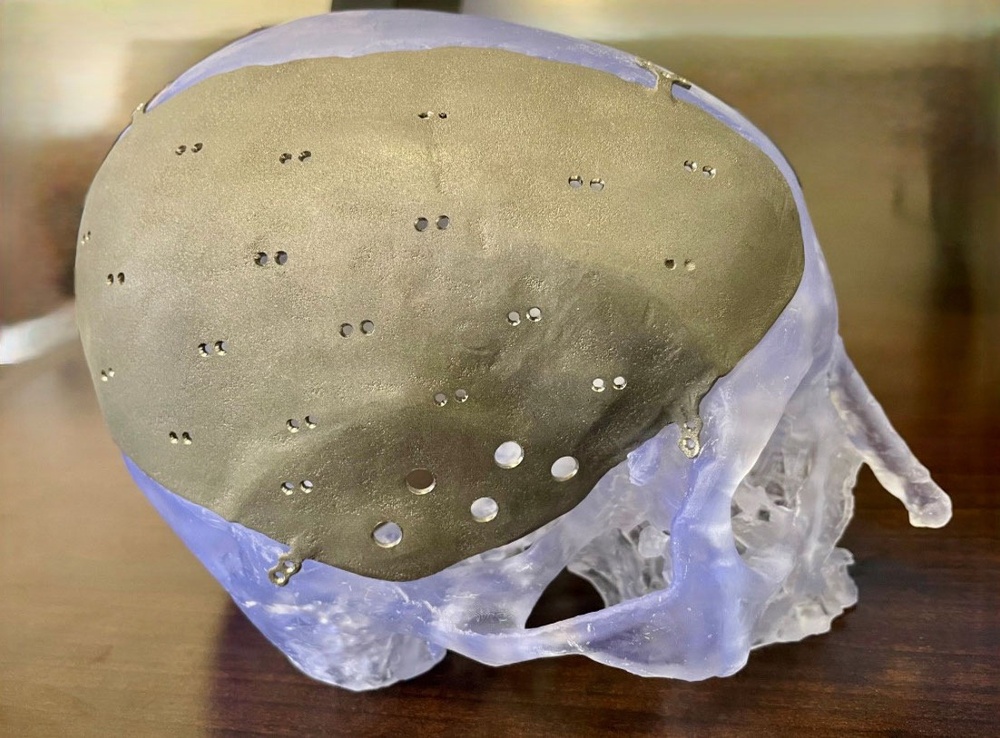
A 3D printing center inside Walter Reed National Military Medical Center has cleared a patient-specific titanium skull implant with the US Food and Drug Administration, putting a hospital in the position usually held by a device company. 3D Systems said on July 28 that it helped the Defense Health Agency and Walter Reed's 3D Medical Applications Center, known as 3D MAC, obtain clearance for the 3D MAC Titanium Cranial Plate System, which the company called the first FDA-cleared implant granted to a point-of-care institution.
The FDA 510(k) record, K253116, lists the applicant as The Surgeon General, Department of the Army. The submission was received on Sept. 24, 2025, and found substantially equivalent on June 18, 2026, under the product code for preformed, non-alterable cranioplasty plates.
A hospital as manufacturer
According to a Defense Department news article published on July 16, the plate reconstructs cranial and facial defects caused by trauma, disease or cancer, and 3D MAC designs and manufactures each one in-house from the patient's CT scans. The center's director of services, Peter Liacouras, said: “While point-of-care 3D printing has been around for quite a while, there have been no clear regulations around it.”
The article said 3D MAC and a Veterans Affairs partner used a joint incentive fund to set up quality management systems, which it described as necessary to comply with FDA regulations. 3D Systems said it worked with 3D MAC on the quality system and on design, validation and the regulatory submission. With clearance, the article said, Walter Reed can distribute the system to other point-of-care facilities within the Department of War and potentially Veterans Affairs. Liacouras described plans for other military sites to design implants under 3D MAC's quality system and within its design envelope, with manufacturing at Walter Reed.
How FDA treats patient-matched printing
FDA's 3D printing page lists orthopedic and cranial implants among devices made this way, and notes that the method lets manufacturers match devices to a patient's anatomy. The agency's thinking on the technical side is in a December 2017 final guidance on additive manufactured medical devices.
That guidance treats patient-matched devices as products made within limits set in advance. They “may be produced within a defined design or performance envelope,” which it describes as the minimum and maximum dimensions, mechanical performance limits and other clinically relevant factors fixed before patient-matching begins. Manufacturers are asked to identify which design parameters can change for each patient, and the range for each.
The guidance also separates these devices from the law's custom device exemption. Patient-matched devices are sometimes called customized, it says, but they are not custom devices unless they meet all the criteria of section 520(b) of the Federal Food, Drug, and Cosmetic Act, and most will fall within the existing regulatory pathway for their device type. For the cranial plate, that pathway was a 510(k).
The open policy question
Printing at the point of care raises questions the 2017 guidance did not settle. In December 2021, CDRH issued a discussion paper on 3D printing medical devices at the point of care. FDA said the paper does not constitute guidance; it set out potential manufacturing scenarios and a possible approach to oversight for public comment, with comments due by Feb. 8, 2022.
Sources
- 3D Systems Enables First FDA Clearance for Implant from a Point-of-Care Institution, 3D Systems, July 28, 2026
- 510(k) Premarket Notification K253116: 3D MAC Titanium Cranial Plate (TCP) System, U.S. Food and Drug Administration, June 18, 2026
- A perfect fit: Walter Reed becomes first point-of-care facility to receive FDA clearance for patient-specific implant, DVIDS (U.S. Department of Defense), July 16, 2026
- 3D Printing of Medical Devices, U.S. Food and Drug Administration, May 12, 2023
- Technical Considerations for Additive Manufactured Medical Devices (guidance document), U.S. Food and Drug Administration
- 3D Printing Medical Devices at the Point of Care: Discussion Paper, U.S. Food and Drug Administration, December 10, 2021