Myeloma Draft Guidance Shows How FDA Accepts Surrogate Endpoints
FDA's January draft on minimal residual disease and complete response in multiple myeloma shows how a lab measure becomes an endpoint that can support accelerated approval, and what it asks of the tests that measure it.

Key points
- FDA published draft guidance on January 21 saying minimal residual disease (MRD) negativity and complete response can serve as primary endpoints to support accelerated approval of multiple myeloma drugs.
- FDA sorts surrogate endpoints as candidate, reasonably likely or validated; reasonably likely surrogates can support accelerated approval, with clinical benefit confirmed later.
- The draft asks that MRD negativity be measured at a threshold of at least 1 in 10^5 tumor cells, with validated assays, and says investigational device rules may apply to the tests used.
The Food and Drug Administration on January 21 published a notice of draft guidance on using minimal residual disease (MRD) and complete response as primary endpoints in multiple myeloma trials intended to support accelerated approval. Comments are due by March 23, 2026. The draft is a narrow document about one blood cancer, but it shows the general process by which a measurement taken in a lab becomes something FDA will accept in place of proof that patients live longer.
What a surrogate endpoint is
A trial endpoint measures an outcome. Clinical outcomes directly measure whether people "feel or function better, or live longer," FDA explains on its surrogate endpoint resources page. A surrogate endpoint stands in for that outcome and is expected to predict it, as lowering systolic blood pressure predicts fewer strokes. Surrogates are used when clinical outcomes would take a very long time to study, or when the benefit of improving the surrogate is well understood.
FDA groups surrogates by how much evidence supports them. Candidate surrogates are still being evaluated. Validated surrogates are backed by a clear mechanism and clinical data showing that an effect on the surrogate predicts a specific benefit, and FDA accepts them as evidence of benefit. In between are "reasonably likely" surrogates, supported by strong mechanistic or epidemiologic rationale but not enough clinical data to be validated. Those can support accelerated approval, which is why the agency stresses continued evaluation after approval.
The 21st Century Cures Act requires FDA to publish a list of surrogate endpoints that were the basis of drug or biologic approvals. FDA also offers sponsors a Type C meeting to discuss a surrogate that has not been used before as the primary basis of approval in a given setting.
Why myeloma needed a new endpoint
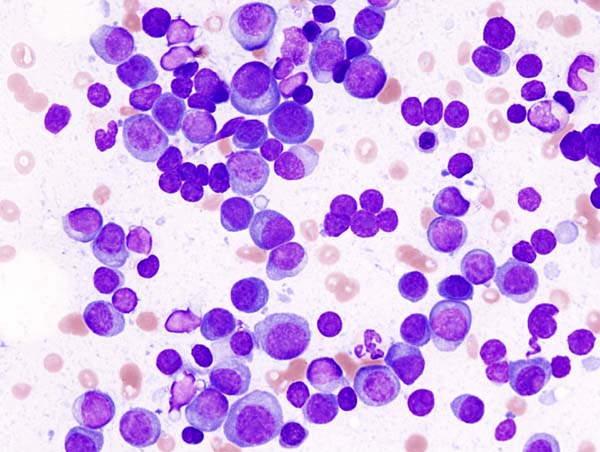
Accelerated approvals in multiple myeloma have relied on overall response rate supported by duration of response, the notice says. But response rates for new drugs now exceed 60 to 70 percent in relapsed or refractory disease and 90 percent in newly diagnosed disease, so showing a statistically significant difference may require "infeasibly large clinical trials." MRD, assessed in bone marrow by flow cytometry or sequencing, measures depth of response beyond complete response, and patients who reach MRD negativity have better long-term outcomes.
FDA's Oncology Drug Advisory Committee reviewed pooled trial analyses linking MRD with progression-free and overall survival on April 12, 2024, and members unanimously agreed MRD was acceptable as an endpoint for accelerated approval in myeloma, according to the notice. FDA's own pooled analysis also linked complete response with those outcomes.
What the draft asks of trials and tests
The draft guidance says MRD can support accelerated approval from single-arm or randomized trials, but prefers randomized trials, which can continue to measure progression-free and overall survival to support traditional approval. MRD negativity should generally be measured at a threshold of at least 1 in 10^5 residual tumor cells, at or near the time of complete response. FDA says there are not yet enough data to use MRD this way in the maintenance setting, smoldering myeloma, monoclonal gammopathy of undetermined significance or extramedullary disease.
Because the endpoint depends on a test, the draft has a section on assays. Sequencing and flow cytometry assays should be validated for accuracy, precision, limits of detection and quantitation and other measures, and their sensitivity should generally be at least one log below the chosen threshold. The draft adds that FDA's investigational device exemption rules in 21 CFR Part 812 may apply when investigational devices are used to detect MRD in a trial, and encourages sponsors to discuss the assay with the drug or biologics center early. The guidance was issued jointly by FDA's drug, biologics and device centers.
Sources
- Minimal Residual Disease and Complete Response in Multiple Myeloma: Use as Endpoints To Support Accelerated Approval; Draft Guidance for Industry; Availability (91 FR 2537), Federal Register (FDA), January 21, 2026
- Minimal Residual Disease and Complete Response in Multiple Myeloma: Use as Endpoints to Support Accelerated Approval (draft guidance), U.S. Food and Drug Administration, January 20, 2026
- Surrogate Endpoint Resources for Drug and Biologic Development, U.S. Food and Drug Administration, July 24, 2018