Medtronic Spine Robot Clearance Shows How FDA Reviews Surgical Navigation Systems
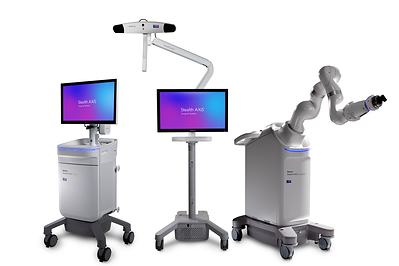
Medtronic's Stealth AXiS was cleared as a Class II stereotaxic instrument by comparison with two earlier Medtronic systems, with bench accuracy tests, cadaver usability work and a literature review standing in for a new clinical trial.
Key points
- FDA cleared Medtronic's Stealth AXiS Surgical System with its spine application on February 12 under 510(k) number K253381, classified as an orthopedic stereotaxic instrument, a Class II device type under 21 CFR 882.4560.
- The 510(k) summary names the Mazor X system and the StealthStation S8 platform as predicates and reports bench accuracy, software and hardware verification, cadaver usability testing and electrical safety testing.
- Clinical support was a retrospective review of published literature for adolescent use; the summary also describes two locked AI features, for screw planning and spine segmentation.
Medtronic announced on February 13 that the Food and Drug Administration had cleared its Stealth AXiS surgical system, which the company describes as bringing planning, navigation and robotics together in one platform for spine surgery. Medtronic said the system's architecture is designed to support future cranial and ear, nose and throat applications, pending further 510(k) clearances. MedTech Dive reported on February 18 that the system builds on the Mazor robotic platform Medtronic acquired in 2018 for $1.64 billion and on its StealthStation navigation technology.
FDA's public records show what such a clearance rests on, and they place a spine robot in a device category whose definition describes a rigid frame and guide mechanism.
A robot classified as a stereotaxic instrument
FDA's 510(k) database entry lists the Stealth AXiS Surgical System with the Stealth AXiS Spine clinical application as K253381, a traditional 510(k) received September 30, 2025 and found substantially equivalent on February 12, 2026. The device classification name is orthopedic stereotaxic instrument, product code OLO, under regulation 882.4560.
That regulation defines a stereotaxic instrument as "a device consisting of a rigid frame with a calibrated guide mechanism for precisely positioning probes or other devices" within the brain, spinal cord or other part of the nervous system, and places it in Class II. The 510(k) summary describes the Stealth AXiS as a computer-assisted surgery system that tracks instruments relative to the anatomy, a process it calls localization or navigation, and says that "With the addition of the Stealth AXiS™ Autopilot to the Stealth AXiS™ Core, the Stealth AXiS™ Surgical System becomes a robotic-assisted surgery system."
Predicates, bench tests and a literature review
A 510(k) is cleared by showing a device is substantially equivalent to one already on the market. The clearance letter and summary name two predicates: the Mazor X system with software version 5.2, cleared in September 2025, and the StealthStation S8 platform, cleared in March 2017, with StealthStation S8 spine software version 2.1 as the predicate for the spine application. Each is also an 882.4560 stereotaxic instrument.
The evidence was largely nonclinical. The summary reports that under a representative worst-case configuration the system showed a mean three-dimensional positional error of no more than 2.0 millimetres and a mean trajectory angle error of no more than 2.0 degrees. It lists software, platform and hardware verification and validation; summative usability testing "by representative users in a simulated clinical environment (cadaver)"; and electrical safety and electromagnetic compatibility testing to IEC 60601 standards. The clinical section consists of a retrospective review of published literature on the StealthStation and Mazor systems in skeletally mature adolescents, the one pediatric use in the indications, which cover pedicle screw placement in that group and interbody device, pedicle screw and iliosacral screw placement in adults.
The summary also includes an AI-enabled device section. It describes an auto-planning feature that recommends pedicle screw placement and an automatic segmentation feature that outlines vertebrae on CT and O-arm images, says users can review, modify or override the outputs, and states that both models are locked and do not update after deployment.
What clearance does not cover
FDA's letter says the agency determined substantial equivalence "for the indications for use stated in the enclosure." It points the company to FDA guidance on deciding when a change to an existing device, including a software change, requires a new 510(k), and reminds it of obligations under the Quality Management System Regulation, adverse event reporting and unique device identification rules. The database entry records that no predetermined change control plan was authorized. The cranial and ENT uses Medtronic mentioned were not part of this clearance.
Sources
- Medtronic receives FDA clearance for Stealth AXiS surgical system, first integrated planning, navigation and robotics platform for spine surgery, Medtronic, February 13, 2026
- Medtronic nets FDA clearance for robotic spine system, MedTech Dive, February 18, 2026
- 510(k) Premarket Notification K253381: Stealth AXiS Surgical System with Stealth AXiS Spine clinical application, U.S. Food and Drug Administration, February 12, 2026
- K253381 clearance letter and 510(k) summary, U.S. Food and Drug Administration, February 12, 2026
- 21 CFR 882.4560 - Stereotaxic instrument (page as updated 2026-10-30; facts cited were in the earlier version), Electronic Code of Federal Regulations