Providence Medical Technology Gets FDA Clearance for 3D-Printed CORUS PCSS 3D-T
The posterior cervical implant adds a porous titanium lattice to the company's existing CORUS PCSS design and was set to debut at the NASS meeting in San Antonio.
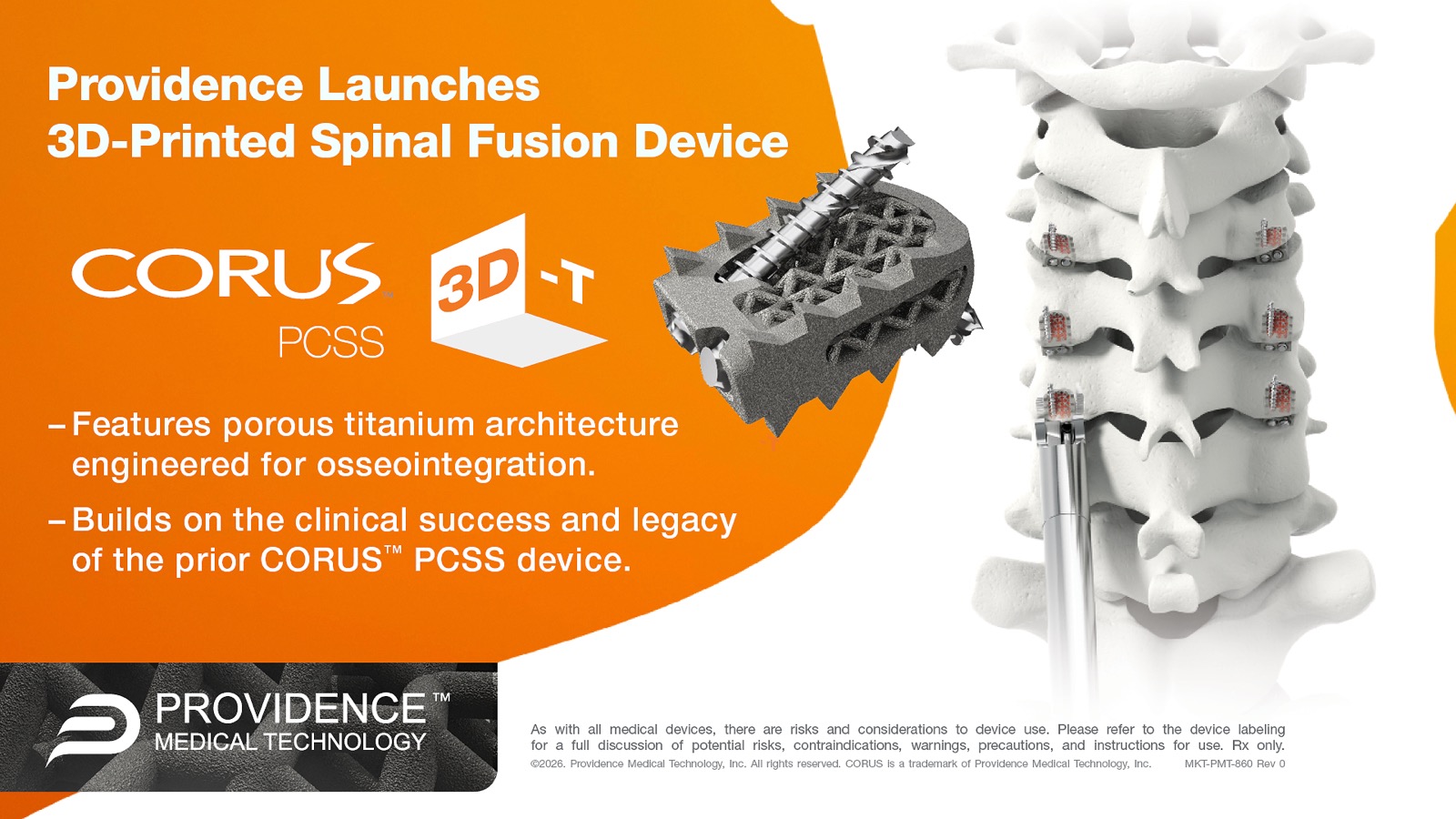
The FDA cleared this device through the 510(k) pathway, which finds it substantially equivalent to a device already on the market. Clearance is not the same as approval.
Key points
- Providence Medical Technology announced 510(k) clearance for the CORUS Posterior Cervical Stabilization System 3D-T on October 13, 2026.
- The device is indicated to immobilize and stabilize spinal segments as an adjunct to posterior cervical fusion in patients with cervical degenerative disc disease.
- The company said the new version keeps the prior CORUS PCSS design, indications and technique while adding a 3D-manufactured porous titanium lattice.
Providence Medical Technology has received FDA 510(k) clearance for the CORUS Posterior Cervical Stabilization System 3D-T, a 3D-manufactured porous titanium version of its posterior cervical implant, the company announced on October 13.
The company said it would show the system for the first time at the North American Spine Society (NASS) 2026 Annual Meeting, held October 14 to 17 in San Antonio. The release did not give the 510(k) number or the date of the FDA decision.
What was cleared
According to Providence, CORUS PCSS 3D-T is a nonsegmental posterior spinal instrumentation device with integrated screw fixation. It is indicated to immobilize and stabilize spinal segments as an adjunct to posterior cervical fusion in patients with cervical degenerative disc disease, a condition in which the discs between the vertebrae of the neck wear down.
The implant is placed on both sides of the spine through a posterior, or rear, surgical approach. The company said it has a proprietary porous titanium lattice engineered to mimic cancellous bone, the spongy inner bone tissue, with porosity and pore sizes chosen to match published literature on bone ingrowth. The lattice is designed to distribute load, provide structural support during fusion and hold bone graft packed inside the device, Providence said.
The company described 3D-T as the next generation of its CORUS PCSS, retaining that device's core design, indications and surgical technique. Like its predecessor, it comes in what the company called the only sterile-packaged, single-use instrument set indicated for posterior cervical fusion.
"With CORUS PCSS 3D-T, we kept the technique surgeons already trust and gave bone a porous lattice to grow into, with 1.5 times the surface area and eight times the surface roughness of the original machined implant, plus room to pack graft inside the device," said Bruce McCormack, MD, the company's co-founder.
Evidence cited for the earlier device
Providence pointed to a randomized clinical trial of the prior-generation CORUS PCSS, registered as NCT04229017. The ClinicalTrials.gov record lists the study, called FUSE, as sponsored by Providence and evaluating the PCSS as an adjunct to posterior cervical fusion alongside anterior cervical discectomy and fusion in multilevel cervical degenerative disease. The company said the trial showed higher fusion rates at 12 and 24 months, and a substantially lower two-year revision rate, when the device was combined with multilevel anterior fusion compared with anterior fusion alone. It said interim results were published in the journal Spine in May 2025. Those results concern the earlier machined implant; the company did not report clinical data specific to the 3D-T version.
The company markets its products around what it calls Total Segmental Fusion, which it describes as stabilizing all three joints of a spinal segment by combining its posterior devices with anterior fusion.
"Clearance of CORUS PCSS 3D-T is an important milestone for Providence and for the surgeons who rely on our platform," said Lane Major, president and chief executive of Providence Medical Technology. "CORUS is backed by Level 1 evidence that's rare in spine, and 3D-T brings the porous titanium surgeons increasingly expect to that proven foundation."
The release did not include pricing or a full commercial launch date.
Sources
- Providence Medical Technology Receives FDA 510(k) Clearance for CORUS PCSS 3D-T, Bringing 3D-Printed Porous Titanium to Its Total Segmental Fusion Platform, Providence Medical Technology press release (PR Newswire), October 13, 2026
- NCT04229017: Study of Posterior Cervical Stabilization System (PCSS) as Part of Circumferential Fusion to Treat Multilevel DDD (FUSE), ClinicalTrials.gov, November 1, 2026