FDA Approves J&J's Tecvayli Plus Darzalex Faspro for Myeloma as Early as Second Line
The approval rests on the Phase 3 MajesTEC-3 trial, in which the bispecific antibody combination cut the risk of progression or death by 83% against standard regimens, Johnson & Johnson said.
The FDA approved this drug or biologic for a specific use.
Key points
- The FDA approved Tecvayli (teclistamab-cqyv) plus Darzalex Faspro for adults with relapsed or refractory multiple myeloma after at least one prior line of therapy, including a proteasome inhibitor and an immunomodulatory agent.
- In the Phase 3 MajesTEC-3 trial, three-year progression-free survival was 83% with the combination versus 30% with standard regimens, and three-year overall survival was 83.3% versus 65.0%, J&J reported.
- The supplemental application was selected for the FDA's Commissioner's National Priority Voucher pilot and also had Breakthrough Therapy Designation and Real-Time Oncology Review.
The FDA has approved Johnson & Johnson's Tecvayli (teclistamab-cqyv) in combination with Darzalex Faspro (daratumumab and hyaluronidase-fihj) for adults with relapsed or refractory multiple myeloma who have received at least one prior line of therapy, including a proteasome inhibitor and an immunomodulatory agent, the company announced on March 5.
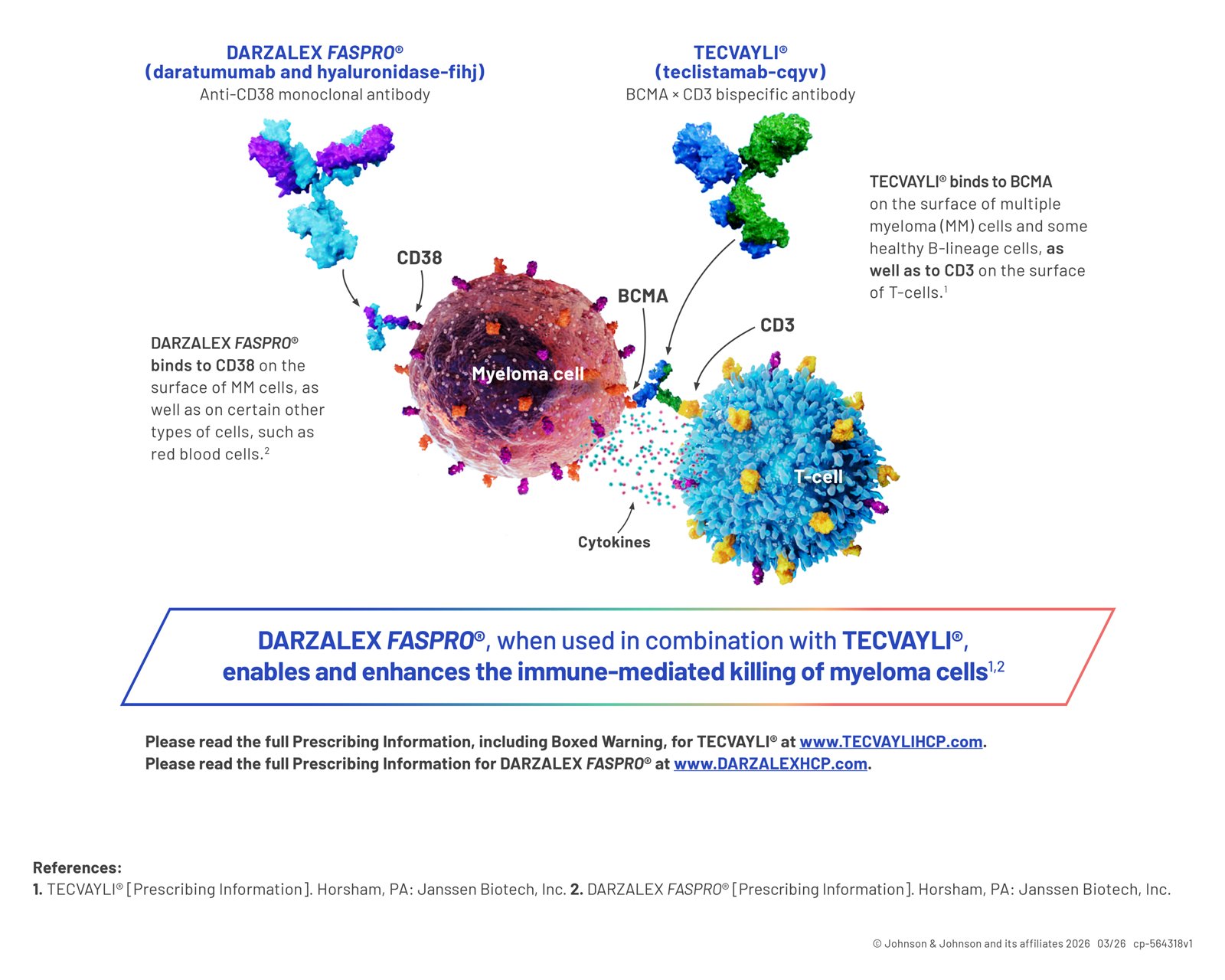
The decision moves Tecvayli, a bispecific antibody that binds BCMA on myeloma cells and CD3 on T-cells, from a late-line monotherapy into combination use as early as the second line of treatment. Tecvayli received accelerated approval in October 2022 for patients who had already received at least four prior lines of therapy. Darzalex Faspro is a subcutaneous antibody that targets CD38.
J&J said the FDA proactively selected the supplemental Biologics License Application for the Commissioner's National Priority Voucher pilot program. The agency also granted the application Breakthrough Therapy Designation and Real-Time Oncology Review.
The MajesTEC-3 results
The approval is based on the ongoing, randomized Phase 3 MajesTEC-3 study, which compared teclistamab plus daratumumab with investigator's choice of daratumumab and dexamethasone combined with either pomalidomide or bortezomib. The results were presented as a late-breaking oral presentation at the American Society of Hematology annual meeting in December 2025 and published at the same time in The New England Journal of Medicine, according to J&J's release.
After a median follow-up of three years, the combination reduced the risk of disease progression or death by 83% compared with the standard regimens (hazard ratio 0.17; 95% CI, 0.12-0.23), the primary endpoint. The three-year progression-free survival rate was 83% versus 30% in the control arm, the company reported.
Overall survival also favored the combination (hazard ratio 0.46; 95% CI, 0.32-0.65), with three-year survival rates of 83.3% and 65.0%. J&J reported an overall response rate of 89.0% versus 75.3%, a complete response or better in 81.8% versus 32.1%, and minimal residual disease negativity in 58.4% versus 17.1%.
"The option to use this regimen as early as second line is particularly important because patients with RRMM often experience multiple relapses and reduced responsiveness to therapy over time," said Luciano J. Costa of the University of Alabama at Birmingham, the trial's primary investigator, in the company's release.
Safety and next steps
Rates of Grade 3 or 4 treatment-emergent adverse events were similar in the two arms (95.1% versus 96.6%), with most due to low blood counts and infections. Grade 3 or 4 infections occurred in 54.1% of patients on the combination and 43.4% on the control regimens; J&J said serious infections declined after the first six months with immunoglobulin supplementation, infection prophylaxis and the switch to monthly dosing.
Cytokine release syndrome occurred in 60.1% of patients, all Grade 1 or 2, and immune effector cell-associated neurotoxicity syndrome in 1.1%. Serious adverse events were reported in 70.7% of patients on the combination and 62.4% on the control regimens, and Grade 5 events in 7.1% and 5.9%. Tecvayli carries a boxed warning for cytokine release syndrome and neurologic toxicity and is available only through a restricted REMS program.
PharmExec reported that J&J filed an application with the European Medicines Agency for the same combination in January, positioning it for use in earlier relapsed disease in Europe as well.
Sources
- Johnson & Johnson Announces U.S. FDA Approval of TECVAYLI plus DARZALEX FASPRO for Relapsed/Refractory Multiple Myeloma, Johnson & Johnson, March 5, 2026
- FDA Approves Johnson & Johnson's Tecvayli as Second Line Treatment for RRMM, PharmExec, March 6, 2026