FDA Clears Philips DeviceGuide AI Software for Mitral Valve Repair Guidance
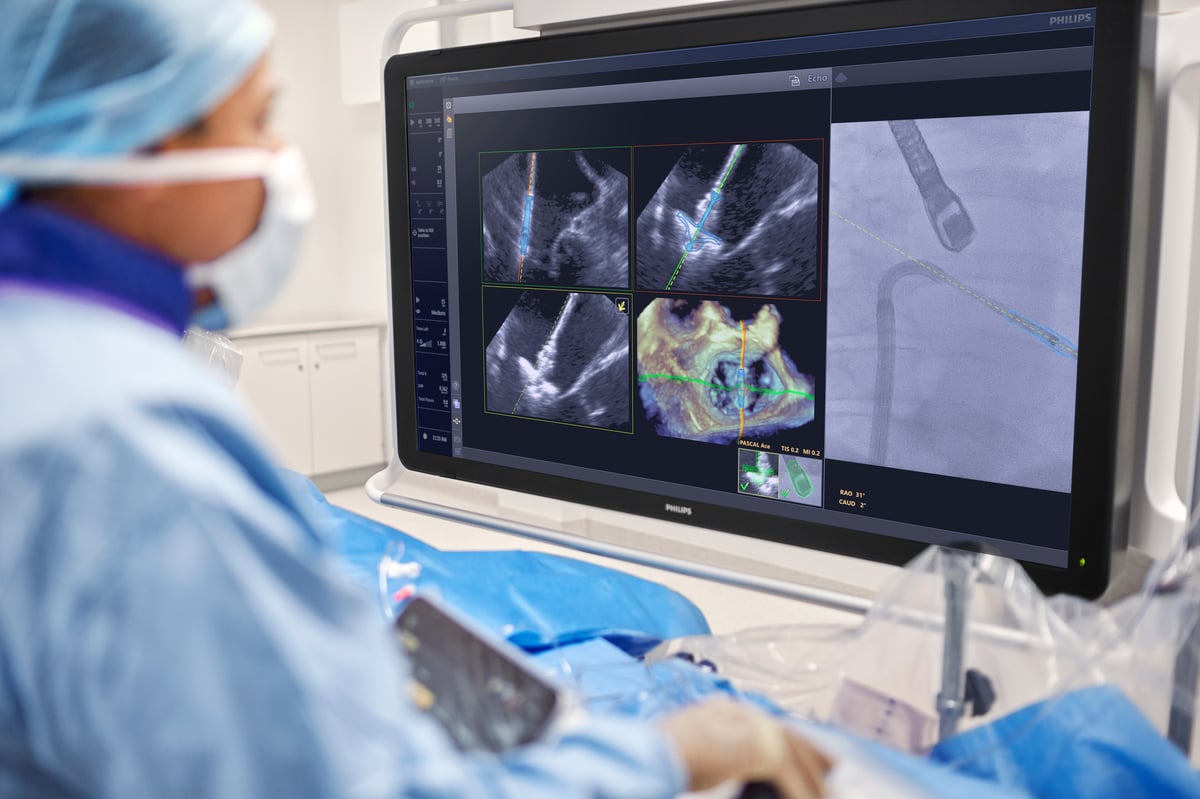
Developed with Edwards Lifesciences, the EchoNavigator R5.0 software tracks the PASCAL Ace repair device across fused ultrasound and X-ray images.
The FDA cleared this device through the 510(k) pathway, which finds it substantially equivalent to a device already on the market. Clearance is not the same as approval.
Key points
- Philips said the FDA cleared EchoNavigator R5.0 with DeviceGuide; FDA records list it as 510(k) K253614, found substantially equivalent on March 17, 2026.
- The AI software tracks the Edwards PASCAL Ace mitral repair device in real time and combines live ultrasound and X-ray into one view during M-TEER procedures.
- It is currently intended only for use with PASCAL Ace; Philips cited a first-in-human case report and said the physician remains in control.
The U.S. Food and Drug Administration has cleared EchoNavigator R5.0 with DeviceGuide, Philips software that uses AI to track the position of a mitral valve repair device in real time during minimally invasive heart procedures, Royal Philips said on March 26 in a press release. Philips developed the software with Edwards Lifesciences.
The FDA's 510(k) records, read through the agency's openFDA database, list EchoNavigator R5.0 as K253614, a traditional 510(k) from Philips Medical Systems Nederland B.V. that the FDA received on November 18, 2025, and found substantially equivalent on March 17, 2026. The device is classified under product code QIH, automated radiological image processing software. Earlier versions of EchoNavigator were cleared in 2012, 2020 and 2022, according to the same records.
What the software does
DeviceGuide is designed for mitral transcatheter edge-to-edge repair, or M-TEER, in which a repair device is guided through a vein to a leaking mitral valve. Philips said the heart team in these procedures must interpret X-ray and ultrasound images on multiple screens, coordinate two operators and make precise adjustments to grasp the moving valve leaflets.
The software builds on Philips' EchoNavigator echo-fluoro fusion technology, which combines live echocardiography from the company's EPIQ CVxi ultrasound platform with live X-ray from its Azurion image-guided therapy system. According to the release, the AI algorithm automatically tracks and visualizes the Edwards PASCAL Ace mitral valve repair device, combining the live ultrasound and X-ray images into one view.
"The AI software serves as an assistive tool; the physician always remains in control. This isn't about replacing expertise – it's about amplifying it," said Atul Gupta, Philips' chief medical officer for diagnosis and treatment.
Philips and Edwards worked with investigational sites in Europe and the U.S., including the Structural Heart and Valve Center at NewYork-Presbyterian/Columbia University Irving Medical Center. "DeviceGuide provides me with a visual overlay, trajectory line and orientation line of the therapy device in both live 3D echo and fluoroscopic images during mitral valve repair procedures," said Susheel Kumar Kodali, the center's director, in the release. The release discloses that Kodali receives consulting payments from Philips North America and that his and Rebecca Hahn's institutions receive funding from Philips and Edwards.
Limits and availability
Philips said DeviceGuide is currently intended for use only with the Edwards PASCAL Ace Mitral Valve Repair System, that commercial availability is subject to market release, and that availability outside the U.S. varies by country. The company said the software supports, but does not perform, the repair itself.
The release points to a first-in-human report in JACC: Case Reports describing early clinical use of the software. Philips did not report results from a larger clinical study.
The company said DeviceGuide will be shown at the American College of Cardiology's 2026 meeting in New Orleans.
Sources
- FDA clears Philips AI solution that provides real-time guidance during complex minimally invasive heart valve repair, Philips, March 26, 2026
- 510(k) records for EchoNavigator, including K253614 (openFDA data as updated 2026; facts cited were in the March 17 decision record), U.S. Food and Drug Administration (openFDA), March 17, 2026